exploring prehistory
Craft your own flint tools like ancient hands, utilizing the same techniques that our ancestors mastered thousands of years ago. Gather the right materials, including select stones and appropriate tools, to begin this fascinating journey through history. With observation and imagination, you can create functional and beautiful pieces that reflect the skill and artistry of those who came before us.
Making Bread
In the tapestry of human development, one thread stands out prominently: the journey of food. And among all the foods that have shaped our history, few have been as pivotal as bread.
Prehistoric hunter-gatherers roamed the Earth, relying on their keen examination of the environment. Over time, they began to observe the wild grains that grew in their surroundings—grains that would eventually become the cornerstone of bread.
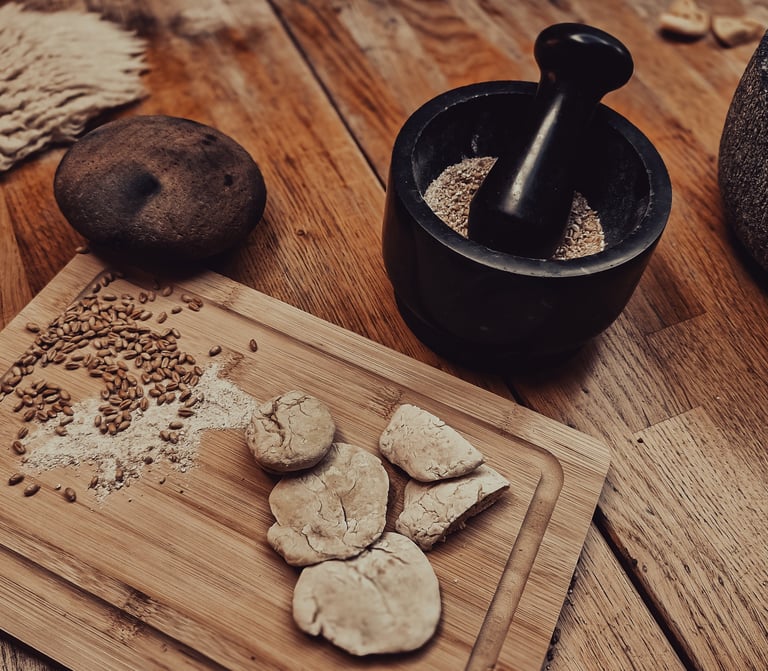
In our workshop we will recreate bread as our ancestors did, realising that our modern bread has not changed much from that first recipe discovered thousands of years ago. Let's get the 3 ingredients that are at the heart of all bread and get baking. Have you got your tools? Are you ready?
Do you know what it takes to make bread?


invention of the wheel
The invention of the wheel marks one of the most significant milestones in human prehistory. This groundbreaking advancement not only transformed the way people moved goods and themselves but also laid the foundation for the development of civilizations, economies, and technologies that we often take for granted today.
The origins of the wheel can be traced back to around 3500 BCE in Mesopotamia, where the earliest known examples emerged. Initially, the wheel did not function as a tool for transportation. Instead, it was used in pottery making, where a circular platform allowed artisans to shape clay more efficiently.
In our workshop we will examine the development of the wheel. We will experience how heavy loads can be moved more easily using our imagination and basic materials around us. Let's retrace and recreate the journey of one of the most significant pieces of human engineering: the wheel!
Where would we be without the wheel?


musical instruments
In prehistoric era, musical instruments were used not only to communicate emotions, but also to warn from danger and therefore were imperial for survival.
Early instruments were created with bones and one of the most notable examples of bone instruments is the flute, which dates back several millennia.
In our workshops we will create all types of instruments, from rattles, drums, simple string instruments, bull roarers, to flutes. It will get noisy!
Prehistoric instruments were often made from bones!


pottery
Pottery is one of humanity's oldest crafts and ceramics is the first artificial material humans created from natural materials.
Originally raw clay was crushed down to gravel. Then water and other additives were mixed into it. Once mixed it could be shaped into pots, vessels and decorative art. Bones and antlers were used to shape, smooth and decorate it.
After drying for several days to get rid of the moisture, the artefact is put into a fire, which turns the soggy clay into a piece of ceramics that can survive thousands of years.
In our workshop, we will follow the original process of creating ceramics with materials that won't need a firing process. Nevertheless, you will walk out a proud creator of an original piece of art that would not have looked all that different in prehistoric times!
When clay meets fire...
FAQs
Who can join?
Kids ages 7 to 12 eager to explore history hands-on.
What do we learn?
We dive into Stone Age life, crafting tools, and storytelling.
Where are workshops held?
Workshops take place in local community centers with safe, engaging spaces designed for hands-on activities.
Each workshop lasts about 2.5 hours, perfect for some creating and lots of fun.
How long is each session?
What should kids bring?
Just their curiosity and a snack; we provide all materials.